
A bit on Andy's Contacts...

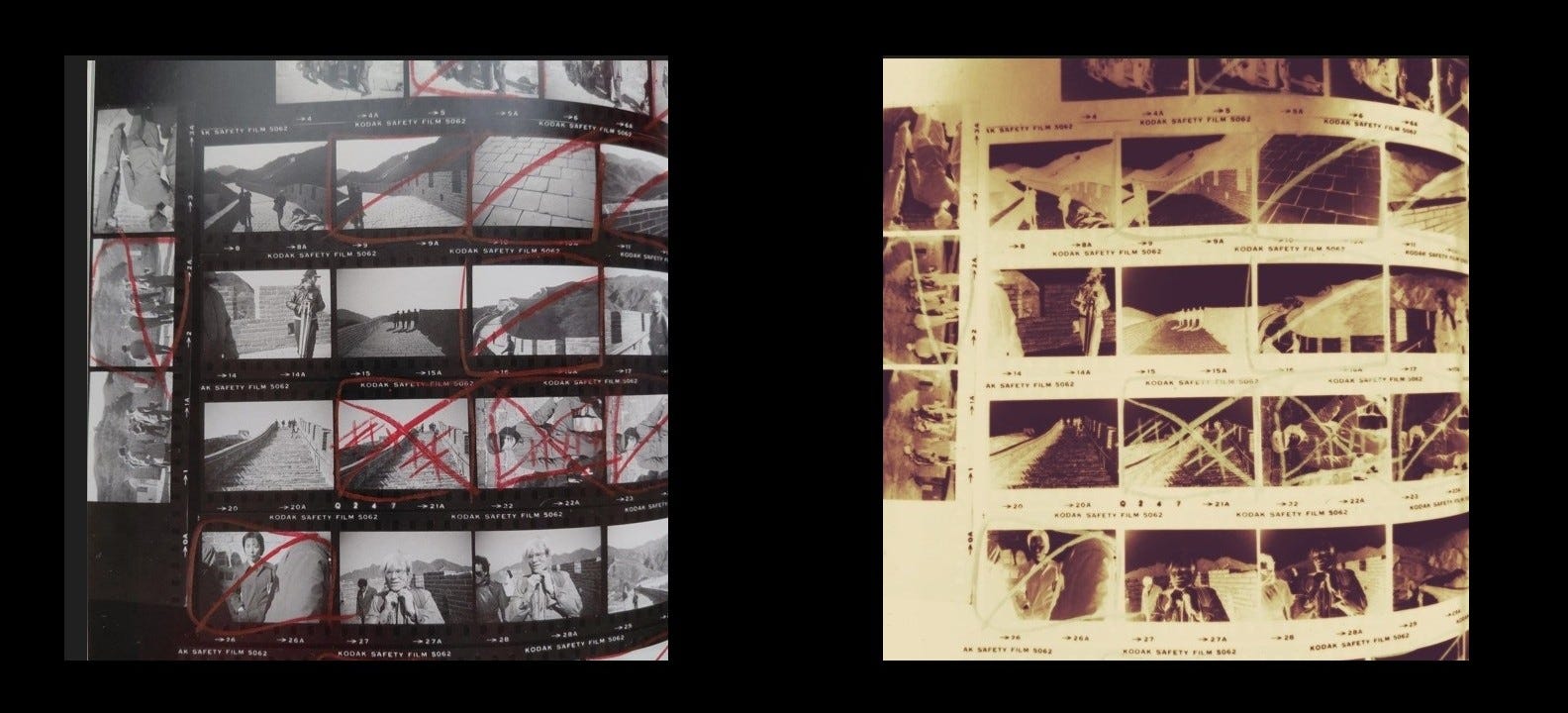
Source: "Contact Warhol: Photography Without End"
Contact and call sheets are such great artistic adventure scapes. In a single frame you can experience a kind of suspended universe, the photographer or filmmaker’s entire process captured and held in one place. This morning I was reading some opinions on beauty in art, and it drove me to revisit Andy Warhol’s contact sheets.
I think Andy was so ahead of his time, much of which we likely won’t understand until even later. I don’t say this in a superficial way. Andy had a wildly cool artistic lens for seeing things and presenting them in ways we can only achieve now with technology and understand only by looking much further inward. That fact struck me all over again while looking at these sheets today.
In a 1985 interview he spoke about his photographs being more of a diary to him. Essentially linking the art he produced directly to the lived experience that created it. That alignment of forces and places fits the definitive meaning of art and aesthetics. The root of “art” is the -ar, meaning “to join,” and “aesthetics” which comes from Greek conceptual thought which refers not just to visual or physical sensation but to something interchangeable and often interdependent between the physical world and the realms of consciousness/perception.
I feel like Andy had a deep sense of that greater alignment in both how he produced his work and how he existed in the world. It’s a stance that is very forward. Art by classical view, is judged by skill against a set of rules or precise physical criteria in the form of physical realism. For example, drawing a dog where the more realistic it is, the “better” it is. Or, less directly, like Rothko’s color fields, where he used physical scale to create a goal: how the viewer would experience intimacy simply by standing in front of the piece and comparing scale between the two.
Painters like Pollock began to flip that script, using physical means to reach an internal goal making perception itself the entire point, rather than the physical object. With Andy’s images, he took all of this even a step further. His view of the photographs as a diary to share with an onlooker didn’t just encapsulate all those earlier concepts at once it moved forward with them them. It allowed the viewer to meet the artist in an intimate connection, sharing a wide scope of life in a single still image. The viewer and the artist could sit down together over that image and see one another's experience.
It leads me, as an artist, to wonder if there is a kind of scale or balance between physical and intellectual/emotional perceptions, set against our shared physicality in any current state. In Andy’s lens it seems, the invention of the camera instantly made even something as simple as “drawing a dog” far more meaningful in terms of the artist’s skill and/or message rather than the product itself. After all, if pure hyper-realism is what you wanted alone, a camera or film would always be more precise. But the fact that the camera exists almost makes the drawn version seem even more interesting and beautiful.
Abstract and contemporary art in non classical senses that lean into meaning and points of view rather than structural realism could very well indeed be more organic than we realize., I find it especially profound that Andy could see a still, unmoving image as something capable of both capturing & sharing a lived experience as opposed to the image acting as a descriptive aid. I don't think that became relatable in a mainstream sense til much later.
Thank you, for the restack @Mark Farley’s wandering’s ! 🙏🌻✨
Apologies for disappearing without a word. (grey matter).
It’s taken a while, for me to fully appreciate the nuanced analysis of your post.
Further exploration required, which I look forward to undertaking. Thank you